Is Stove Repair Worth It? When to Fix vs. When to Replace Your Range
Every homeowner eventually faces that frustrating moment in the kitchen: dinner is halfway prepped, and the stove suddenly stops cooperating. When an essential kitchen appliance acts up, the immediate dilemma is almost always the same: do you call for professional stove repair, or is it finally time to cut your losses and buy a replacement?
As a service technician, I see homeowners struggle with this choice every single week. Some throw away perfectly good units over minor, inexpensive fixes, while others pour hundreds of dollars into appliances that are already running on borrowed time. Deciding whether to repair or replace your stove comes down to clear safety boundaries, straightforward financial math, and understanding the unique realities of your specific setup.
The Absolute Point of No Return: Structural and Safety Hazards
There are plenty of mechanical issues that are simple to fix, but there is one definitive issue where I advise clients, without hesitation, to stop spending money on repairs: a compromised, cracked, or severely rusted internal chassis structure.
When rust rots through the metal around the burner box or the oven cavity lining warps, the problem ceases to be a typical fixable issue. Once structural steel integrity fails, heat, open flames, and combustion gases escape past their engineered thermal seals. At that stage, your appliance transitions from an inefficient kitchen tool to an active fire and carbon monoxide safety hazard.
Trying to patch or replace individual components on a degraded frame is like putting brand-new tires on a vehicle frame that has snapped in half. It is unsafe, unreliable, and simply does not make practical sense. When the structural chassis or oven cavity is compromised, your only safe path forward is installing a brand-new appliance.
The Formula: How to Weigh Stove Repair Against Replacement
If your stove is structurally sound, the decision comes down to financial common sense. Homeowners often ask if there is a reliable rule of thumb to help them make the call without guessing.
A practical formula you can use is simple: multiply the estimated quote for your stove repair by the age of the stove in years. If that total exceeds the cost of purchasing a brand-new, comparable unit, replacement is the smarter investment.
Consider how this works in practice:
- An 8-year-old stove needs a $250 component replaced.
- Multiplying 8 by $250 gives you $2,000.
- Because $2,000 far outstrips the retail cost of a solid new freestanding range, sinking that money into an aging appliance is essentially throwing cash down the drain.
Beyond the formula, keep these practical dealbreakers in mind:
- The 10 to 12-Year Lifespan: Most residential stoves have an average useful life of roughly a decade. Once you push past that window, internal components begin failing in rapid succession.
- Repeat Breakdowns: If you have called a technician two or more times over the past twelve months, the machine is signaling systemic failure.
- Parts Obsolescence: If sourcing a factory replacement board or switch requires weeks of searching salvage sites or paying exorbitant aftermarket markups, the unit has reached the end of its serviceable life.
A Cautionary Tale: The Sunk Cost Trap
Walking away from an appliance after paying for a fresh repair feels counterintuitive, but chasing sunk costs is the easiest way to waste your hard-earned money.
A homeowner I worked with looked at the sleek glass cooktop of her eight-year-old electric range, reluctant to admit it was giving up on her. When the main surface heating element began cutting out mid-meal, she promptly scheduled a stove repair service. The estimate to swap out the surface burner was reasonable enough, so she approved the work.
Two weeks later, the digital display went completely dark. Rather than stepping back to evaluate the bigger picture and the age of the unit, she focused entirely on the money she had already invested. She paid for a costly new main control board, convincing herself that with these fresh parts installed, she practically owned a brand-new appliance.
The turning point came three months down the line. The lower bake element burned out with a loud pop, taking a secondary electronic module down along with it. Sitting at her kitchen table looking over the stacked receipts, the math was brutal: she had spent nearly $900 in piecemeal fixes over ninety days on an aging stove that could have been replaced entirely for $800.
Knowing when to cut your losses early protects your wallet from the snowball effect of compounding repairs.
How Fuel Type Changes the Replacement Equation
Not all stoves fail in the same manner. The fuel powering your cooktop fundamentally alters what you should watch for and when you should replace the appliance.
Gas Stoves
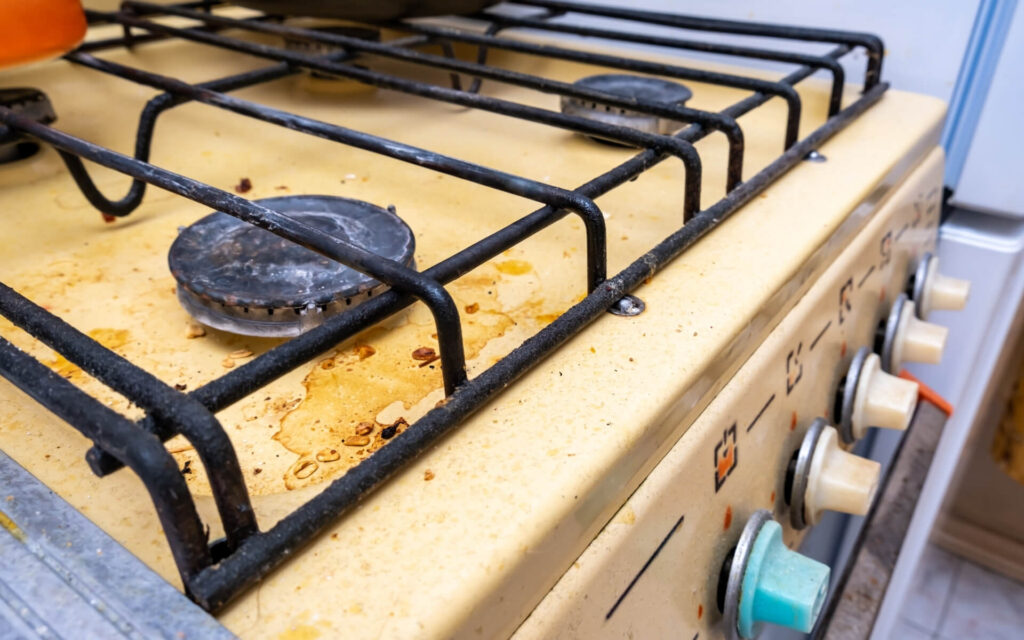
Gas ranges are mechanical workhorses that can deliver reliable performance for years. However, their reliance on combustible fuel means safety margins are razor-thin. Any persistent odor of unburned gas, a rusted burner manifold, or rust through the lower combustion box is an urgent hazard. When the delivery system for natural gas or propane corrodes, do not gamble on patchwork repairs—replace the unit immediately.
Standard Electric Stoves
Traditional coil and radiant glass electric ranges are generally straightforward and cost-effective to service when standard switches or elements burn out. However, if the smooth glass-ceramic surface suffers a deep crack, or if the internal insulation surrounding the oven cavity becomes saturated or degraded, the repair bill quickly rivals the price of an entry-level replacement.
Induction Cooktops
Induction ranges are marvels of cooking speed and energy efficiency, but they are also complex electronic devices. Instead of simple mechanical valves or resistance coils, they rely heavily on high-voltage power boards, sensor arrays, and dedicated internal cooling fans. When these high-end electronic modules fail, parts and labor frequently approach 70% of the stove’s original purchase price. For this reason, a major electronic failure on a mid-life induction unit often pushes the smartest financial decision straight toward a full replacement.
Buyer Beware: Hidden Installation Realities
Once you make the call to buy a new stove, do not assume the replacement unit will simply slide right into your existing kitchen footprint without preparation. Big-box store sales reps rarely mention the architectural and utility adjustments that new models often require.
Before finalizing your purchase, inspect these critical details:
- Electrical Panel Amperage: If you are transitioning from a standard radiant electric range to a high-powered induction model, verify your home’s breaker panel first. Older setups typically run on a 40-amp circuit, whereas many modern high-output induction ranges demand a dedicated 50-amp line.
- Gas Plumbing and Shutoffs: Building codes evolve over time. Replacing an older gas stove often reveals outdated rigid steel connections that must be upgraded to modern flexible corrugated lines and accessible, code-compliant ball shutoff valves.
- Ventilation Capacity: High-BTU gas burners and fast-heating modern cooktops produce significantly more grease, moisture, and ambient heat, frequently necessitating a dedicated, ducted range hood rather than an older recirculating filter.
- Exact Cutout Dimensions: Never rely on general catalog descriptions like “standard 30-inch range.” A mere quarter-inch variance in your countertop cut, cabinet depth, or rear gas stub-out location can keep a modern slide-in unit from sitting flush against your backsplash.
Checking your electrical capacity, measuring physical cutout depths down to the millimeter, and assessing your supply lines beforehand ensures your transition to a new stove is smooth, safe, and free of expensive delivery-day surprises.