An oven not heating is the last thing you want to discover the week of Thanksgiving. Our technicians at All Valley Appliance Repair get more of these calls in late November than any other month, because ovens that sat idle all summer suddenly have to roast a turkey for five hours. The good news is that many problems have a simple cause. So before you cancel dinner, work through the checks below.
This guide comes from what our team sees on real service calls across Caldwell, Nampa, Boise, and the rest of the Treasure Valley. It covers what you can safely check yourself, what usually fails, and when it is time to book professional oven repair.
Table of Contents
Why Is My Oven Not Heating? The Short Answer
In most homes, an oven not heating comes down to one of five things. First, the oven is not getting full power or gas. Second, a heating element or gas igniter has failed. Third, the temperature sensor is giving the control board a bad reading. Fourth, a safety part such as a thermal fuse has tripped. Finally, the control board or a setting like Sabbath mode or a delayed start is stopping the heat.
Electric and gas ovens fail in different ways, so it helps to know which type you have. After that, the symptoms usually point straight to the cause.
7 Easy Checks When Your Oven Is Not Heating
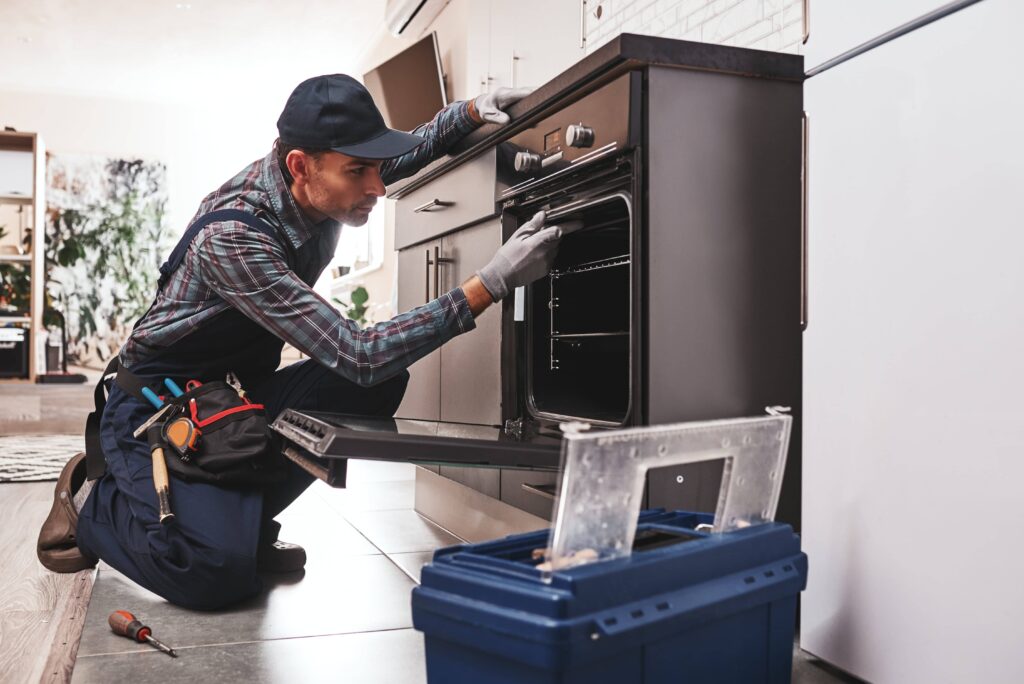
Start with the simple checks for an oven not heating. In fact, about one in five calls we get could have been solved with one of these steps.
1. Check the Breaker and the Power Supply
Electric ovens use a 240-volt circuit with a double breaker. If only one half trips, the display and light may still work, yet you are left with an oven not heating at all. So flip the oven breaker fully off, wait 30 seconds, and then turn it back on. For a gas oven, also confirm the cord is plugged in, because the igniter still needs electricity.
2. Make Sure the Gas Is On
If you have a gas range, check that the shutoff valve behind the unit is parallel with the gas line. Also try a stovetop burner. When the burners light but the oven does not, the gas supply is fine and the problem is inside the oven.
3. Look for a Delay Start, Lock, or Sabbath Mode
Modern ovens have many settings, and some of them block heat. For example, a delayed start or Sabbath mode can make it seem like the oven is not heating at all. Check the display for a lock icon or timer. If you are not sure, the owner’s manual will show how to clear them.
4. Watch the Bake Element
On an electric oven, set it to bake at 350°F and watch the lower element. After a minute or two, it should glow orange. If it stays dark, or you see a blister, crack, or burned spot, the element has likely failed. That is the top cause of an electric oven not heating. The broil element works the same way on the top.
5. Listen and Look at the Gas Igniter
On a gas oven, the igniter must glow bright orange and get hot enough to open the gas valve. A weak igniter still glows, but it never gets hot enough. As a result, you will see a glow but no flame, or the flame may take more than 90 seconds to appear. That is one of the most common causes of a gas oven not heating.
6. Test the Temperature With an Oven Thermometer
Sometimes the real issue is an oven not heating fully. Place an inexpensive oven thermometer in the center and preheat to 350°F. Then wait 20 minutes. If the reading is 25 degrees or more off, the temperature sensor or the control may be at fault. Our older post on oven temperature problems explains this in more detail.
7. Check for Error Codes
Many ovens show a code such as F1, F2, F3, or F9 when something goes wrong. Write the code down before you reset anything. That code tells our technician which part to test first, and it often means we can bring the right part on the first visit.
Common Parts That Fail When an Oven Is Not Heating
When the simple checks do not fix an oven not heating, one of these parts is usually the reason.
- Bake or broil element: Elements burn out with age, and a visible break is a sure sign.
- Gas igniter: This is the most common failure on gas ovens, especially after a few years of heavy use.
- Temperature sensor: A bad sensor makes the oven run too cold, too hot, or not heat at all.
- Thermal fuse: This safety part trips when the oven overheats, often after a self-clean cycle.
- Relay or control board: If the board does not send power to the element, the oven stays cold.
- Gas safety valve: On gas models, a valve that will not open stops the flame.
A trained technician will test each part with a meter instead of guessing. That way, you only pay for the part that has actually failed.
Why We See More Ovens Not Heating Before the Holidays
There is a pattern every year in Canyon County and Ada County. Many families run the self-clean cycle right before Thanksgiving so the oven looks good for guests. However, self-clean runs at more than 800°F for several hours. That heat is hard on thermal fuses, sensors, and control boards, and we often find an oven not heating right after the cycle.
So our advice is simple. Clean the oven by hand this week instead, and save self-clean for January. If you want a gentler method, see our guide on cleaning an oven naturally.
Is It Safe to Fix an Oven Not Heating Yourself?
Some checks are safe for any homeowner, such as resetting the breaker or clearing a setting. Replacing an element is also possible for handy owners, as long as the power is fully off at the breaker.
However, gas parts are a different story. A gas igniter, valve, or burner should be handled by a trained technician. Gas leaks and carbon monoxide are real risks. If you ever smell gas, leave the home and call your gas utility from outside. The U.S. Consumer Product Safety Commission also recommends a working carbon monoxide alarm in every home with gas appliances.
Repair or Replace an Oven That Is Not Heating?
In most cases, an oven not heating is worth repairing. Elements, igniters, and sensors are affordable parts, and the repair is often done in one visit. On the other hand, if your oven is more than 15 years old and needs a control board, replacement may make more sense. Our guide to repairing or replacing an appliance can help you decide.
Fast Oven Repair in Caldwell, Nampa, Boise, and Nearby
All Valley Appliance Repair is a local, family-owned company based at 515 S 2nd Ave in Caldwell. We are licensed and insured, and we are approved by most major manufacturers for in-warranty repairs. Our customers rate us 4.9 stars across more than 140 Google reviews.
We service ovens and ranges from Whirlpool, GE, Samsung, LG, Frigidaire, Bosch, KitchenAid, Wolf, and many other brands. Our technicians cover oven repair in Caldwell, Nampa, Boise, Meridian, Eagle, Parma, Payette, and Ontario, Nyssa, and Vale in Oregon. If you also cook on a gas or electric range, our range repair team can check the cooktop on the same visit.
Holiday weeks fill up fast, so call (208) 800-1955 or request repair service online as soon as you notice your oven not heating.
Frequently Asked Questions
Why is my oven not heating but the stovetop works?
When the burners or cooktop elements work but the oven stays cold, the power or gas supply is usually fine. The most likely causes are a failed bake element, a weak gas igniter, a tripped thermal fuse, or a faulty temperature sensor.
How long does it take to fix an oven that is not heating?
Most oven repairs take one to two hours once the technician has the part. Common parts like elements and igniters are often on our trucks, so many ovens are fixed on the first visit.
Can a bad igniter cause a gas oven not to heat?
Yes. A weak igniter can still glow but not draw enough current to open the gas valve. The oven then stays cold or takes a very long time to light. This is one of the most common gas oven repairs we do.
Should I use the self-clean cycle before Thanksgiving?
We suggest waiting. Self-clean runs at very high heat and can trip a thermal fuse or damage a control board in an older oven. Clean by hand before the holiday and run self-clean after.
Do you repair ovens that are still under warranty?
Yes. All Valley Appliance Repair is approved by most major manufacturers for in-warranty repairs. Call us with your model and serial number and we will confirm coverage.